
Mario Calderara (1879-1944) is one of the most important Italian aviation pioneers, holder of the pilot license no. 1 in Itay (issued by Federation Aeronautique Internationale in 1910). In addition to aviator, he contributed to the development of airplane flight as inventor, having designed and realized various prototypes including the Goupy-Calderara biplane, considered among the first aiplanes of modern conception in respect to when it was built (also for having a tractor propeller) and the Calderara seaplane, which in 1912 was the largest existing aiplane in the world. Also for this reason he is considered as one of the fathers of naval aviation.

Mario Calderara was born in Verona on October 10th, 1879, the elder son of an army officer, Marco, and Eleonora Tantini. Marco Calderara (1848-1928) reached the rank of general of the “Alpini” corps. Eleonora Tantini died at the age of fifty,when Mario was 21 year old.
The passion for flying
Since his early childhood Mario was attracted by life at sea. In 1898 he entered the Naval Academy in Livorno, and graduated as a midshipman in 1901. During his Livorno years he was known by his classmates for always dreaming about human flight, something which was totally unknown in those days, except for the successful gliding flights of Otto Lilienthal (who fell to his death in 1896) and the aborted powered flight of Clement Ader in France. Mario’s classmates were joking about his flying mania, and one of them made a sketch of Calderara on a flying machine, crashing to the ground and being carried to a hospital, and then to a cemetery.
Correspondence with the Wright Brothers and early experiments
In 1905, Mario Calderara wrote to the Wright brothers in Dayton Ohio, after hearing about their successful attempts at flying (a documented record of their flights was known only after 1905). He asked them about technical details and was pleasantly surprised when he received a satisfactory answer from Wilbur and Orville, as well as from F.C. Bishop, president of Aeroclub of the United States. This correspondence continued during the following years and formed the basis of a friendship which lasted throughout his entire life. Calderara had already made some experiments in 1903 and 1904 with primitive gliders, and had studied the behavior of a flat surface on an incline calculating its coefficient of resistance to the wind (together with the Italian engineer Canovetti, he utilized the funicular from Como to Brunate as a slope for making his calculations).
Flight experiments in the Gulf of La Spezia
After having received information from the Wright brothers, Mario Calderara requested permission from the Italian Navy to carry out some gliding experiments on water, towed by a motor boat. Permission was granted in 1906, and in the spring of 1907 he started his first gliding experiments, in the gulf of La Spezia, with a “flying machine” inspired from the Wright biplane. At first he placed the glider on floaters, and held it with ropes which would gradually release the glider allowing a controlled lift. He ultimately installed his machine directly on the deck of the destroyer “Lanciere” and attempted to soar at a much higher height, taking advantage of the warship’s higher speed. He did reach a height of more than fifteen meters, but when the destroyer made a sharp turn to the left, the glider lost its balance and dived into the water. Calderara was dragged underwater by the glider’s steel wires at a depth of more than three meters. He was carried to a hospital half drowned and slightly wounded and was forbidden to continue his experiments which were considered as too risky.

The Calderara-Goupy biplane
In 1908, the French pilot Leon Delagrange visited Rome in preparation for flight demonstrations. The airplane manufacturer Gabriel Voisin accompanied him, and Mario Calderara asked Voisin if he could come to Paris and work in his shop as a draftsman and designer. Voisin agreed, and Calderara applied to the Italian Admiralty for a six months leave of absence without pay. In July 1908 he traveled to Issy Les Moulineaux (near Paris) and worked in the shop of Gabriel Voisin (The two had become very good friends and collaborated on new ideas). After helping in the design of several airplanes, he was offered by Mr. Ambroise Goupy , a wealthy Frenchman who was interested in flight, the opportunity of designing and manufacturing, funded by Goupy, a new type of flying machine, very light and small: a “tractor propelled biplane”, the first of its type. He built the airplane, called “Calderara Goupy” and flew it successfully on March 11th , 1909 in Buc (France).


The flight in Centocelle
In those months (summer 1908) Wilbur Wright had been invited to visit France and had been demonstrating the potentialities of his marvelous “Flyer” which could carry out extended flights with a duration of thirty to sixty minutes, while the French airplanes manufactured by Blériot, Voisin and Farman could only stay in the air for a few minutes. The Italian Aeroclub, acting in coordination with the Italian army’s “Brigata Specialisti” headed by major Maurizio Moris, invited Wilbur Wright to Rome and offered to purchase one of his airplanes. Wilbur Wright was asked to train one or two Italian pilots on the fields of Centocelle (Rome’s future airport). Mario Calderara was selected as the first trainee, because he was the only person in Italy with the required references.
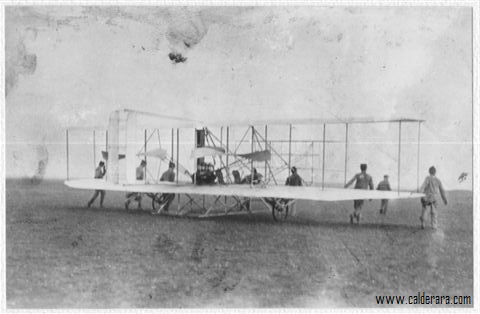
Wilbur Wright came to Rome in April 1909 and , after having carried many VIPs as passengers on his machine, gave a few lessons to Mario Calderara and, in the last days, to army lieutenant Umberto Savoja, of the corps of engineers. Wilbur Wright left for the United States on may first, stating that Mario Calderara was in a position to fly alone and to teach flying to lieut. Savoja. After his departure, Mario Calderara made many prolonged flights without any problems, but on a windy day, on May 6th, his airplane crashed and he was seriously wounded (concussion of the brain). After recovering in the hospital, he managed to repair the Wright airplane with the assistance of Umberto Savoja, who was a very good engineer, and after a month and a half (July l909) he resumed the flights in Centocelle.
The Brescia International Air Rally
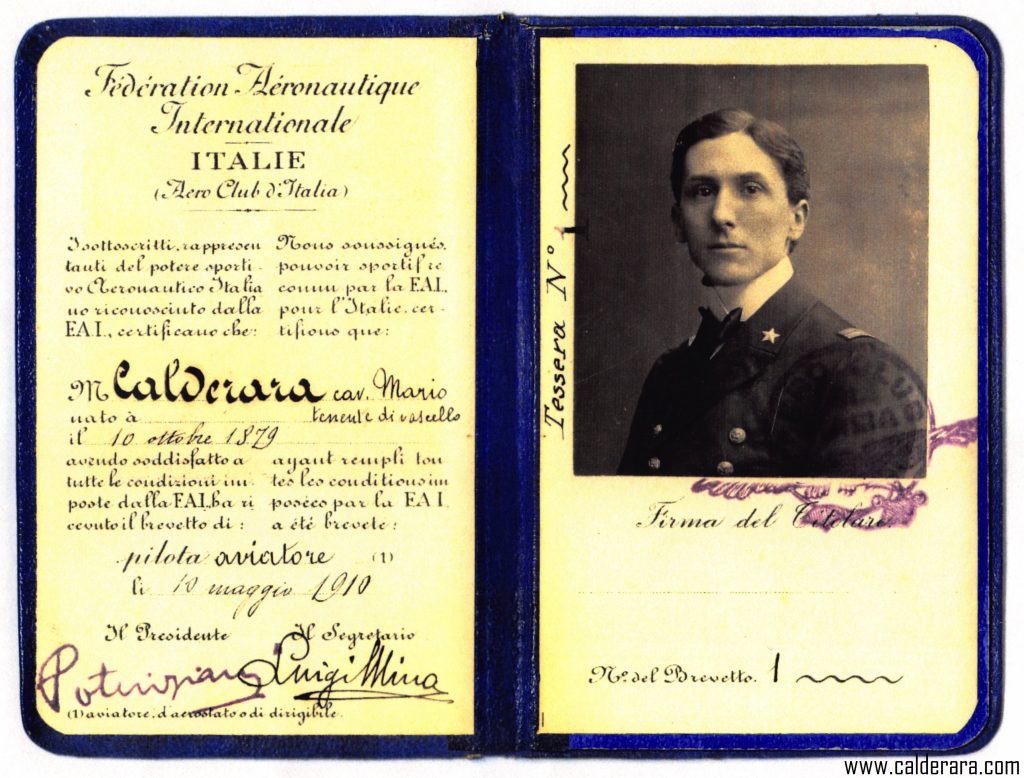
In September 1909, the Aeroclub of Italy called for an international air rally in Brescia (a similar rally had taken place in Reims, France, in July). Calderara was allowed to participate in this competition, which would be attended by King Victor Emanuel in person. Three weeks before the rally, a violent tornado destroyed the canvas hangars built on the Brescia airport for the participants, and the Wright flyer which had been already rebuilt in Rome was damaged beyond repair. The two officers ( Calderara and Savoja) managed to rebuild the biplane in 9 days, using second quality wood and canvas, in time for the rally. After mounting a new Italian motor, a “Rebus”, on the flying machine, Mario Calderara competed in all prescribed tests and won five out of eight prizes which were being offered. The other Italian pilots which attempted to participate did not manage to lift their machines in the air, except Anzani on a French airplane which crashed beyond repair. The other pilots who flew successfully were the American Glenn Curtiss and the French Henry Rougier. The Brescia rally was a triumph for Calderara, who became a national hero overnight as the only Italian who could fly. He was awarded Flying License n.1 by the Italian Aeroclub.
The famous Italian poet Gabriele d’ Annunzio was interested in human flight and had come to Brescia hoping to be carried on an airplane as a passenger. He made a first aborted flight of a few seconds with Glenn Curtiss and was disappointed; then asked Calderara, whom he had met in Centocelle, to carry him aloft. The latter accepted and took d’Annunzio on a ten minutes flight around the airport. D’Annunzio was elated and praised emphatically Calderara’s skills. At the time the poet was writing a novel about human flight which revived the myth of Dedalus and Icarus. He made the hero of his book Paolo Tarsis temperamentally similar to Mario Calderara seen as a hard tempered pilot with quick reflexes.
The difficulties and the bitterness
Calderara’s notoriety caused him to be subjected to repeated interviews by journalists, and his willingness to explain his flying technique was not appreciated by his direct superior in rank, major Moris who believed this was not dignified on part of a career officer (This may have marked the beginning of a falling out between the two officers). During the next few months, Calderara underwent his exams for a graduate course in Livorno ( which were required for his promotion to Lieutenant) and was promoted with low grades because his flying had diverted him from his naval activities, and this damaged his career.
Major Moris had accepted to utilize, after fitting it with a motor, his little airplane, the Calderara Goupy biplane (which arrived from France without motor) for training Italian pilots. But in the fall of 1910, during Calderara’ s absence the airplane, which had been stored in the Centocelle hangar, was moved outside and left exposed to bad weather. Soon rain and wind damaged the airplane beyond repair and it had to be demolished. This was a source of terrible disappointment for Calderara, who shortly afterwards was assigned to the Ministry of the Navy and was not utilized anymore as an instructor for new pilots.
The Calderara seaplane
Calderara applied to the Admiralty for permission to build in La Spezia a new type of airplane in which could take off and land on water. Seaplanes did not exist at the time, except for a French seaplane designed by Fabre, which had many drawbacks.

Calderara designed and built his seaplane, the largest flying machine in the world, in 1911, and flew it very successfully in the spring of 1912, carrying three passengers plus the pilot in flight. He was invited to London, where he projected a film of his flights to a selected public which included the Honorable Winston Churchill.
The First World War and the Bolsena School of flight
World war one was approaching and the Italian Navy imposed on Mario Calderara an interruption of his aeronautical activities, and a return to his naval assignments. During the war, Calderara was on board of several warships, and ultimately was in command of a torpedo ship in the Adriatic sea.
Towards the end of 1917, the Admiralty entrusted him with the command of a new school for pilots of seaplanes to be located on the shore of the Bolsena lake, north of Rome. The trainees were American naval officers (America had just entered the war) and the school was active throughout 1918 and until July 1919. Calderara’s record in training the American pilots was considered as fully successful, with no casualties at all in 18 months, an exceptional demonstration of safety and skill in those days. The U.S. Navy was impressed by the capacity of Lieut. Commander Calderara, and awarded him the American Navy Cross.
The years in Washington and Paris
After the war, in 1923, Calderara was assigned to the Italian embassy in Washington as air attaché. He carried out his task with the utmost skill and met many American statesmen, including president Coolidge and president-to-be Herbert Hoover. He also renewed contacts with his old friends of the pioneering days. He visited Glenn Curtiss and Orville Wright and established new friendships with people involved with the aviation industry.
His assignment in Washington ended in 1925, and he decided to interrupt his career in the Italian Navy (in which he had attained the rank of commander). He moved to Paris, France with his family and used Paris as a center for his new activity, representing several U.S. corporations which manufactured airplane motors and instrument panels. His new work required a great deal of traveling in European countries as well as the Soviet Union and Turkey.
His new activity was very successful, in spite of the 1929 crash of the Stock Exchange in New York. But a new world conflict was now approaching, and in 1939 Calderara had to move again and seek protection in Italy. When war burst out, the house which Calderara had bought near Paris was expropriated as enemy property, and the family suffered further financial losses. In 1944, worn out by challenges as well as by his chain smoking habit, Mario Calderara died suddenly in his bed. His beloved wife, countess Emmy Gamba Ghiselli, lived for 38 years after his death. She contributed substantially to the collection of documents which constitute a heritage of Mario Calderara.
| Want to find out more about Mario Calderara? Visit the other pages of calderara.com. You will find an overview of the website, information on the Association which is behind it and additional historical facts on the about page; lots of reliable reference material on web library, where you will also find information on memorabilia to be found in various museums; and, finally, a regularly updated section containing all events and news on the events page. |